

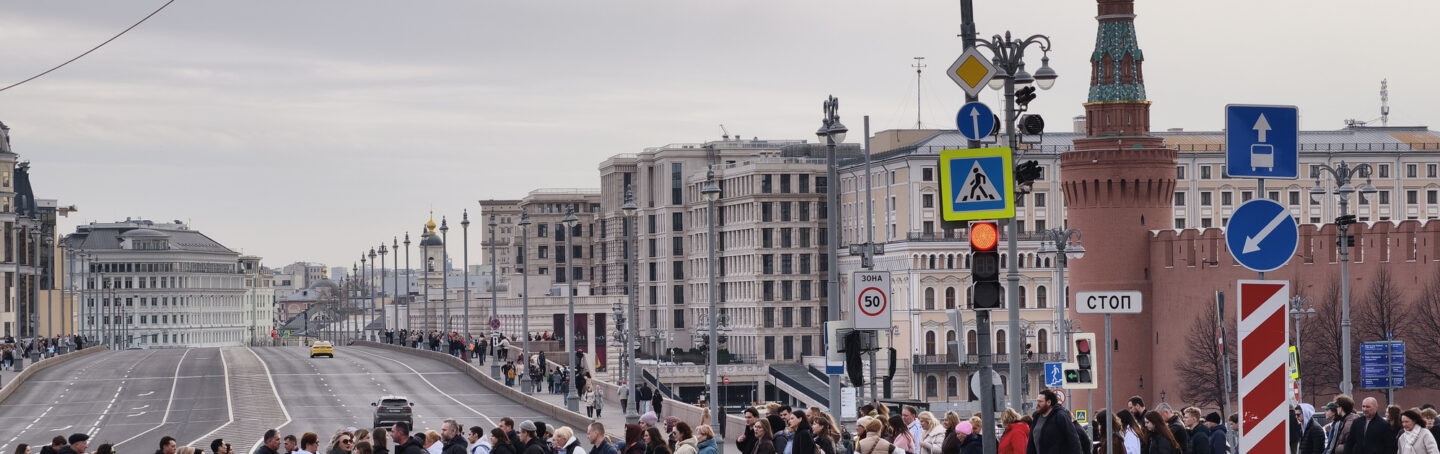

Last month, Independent Women’s Center for American Safety and Security brought together some of the brightest foreign policy thinkers for an honest debate on the threat Russia poses to the U.S. The day-long seminar featured a variety of perspectives on how the U.S. might best deal with this threat, but one point of consensus was that the conversation itself is vital—especially now. It should not be that room for an honest discussion about Russia has narrowed at the very moment the threat from Russia has widened.
Americans likewise are asking serious questions. They want to know what our interests are, what strength requires, what Ukraine has to do with American security, and whether Washington, D.C. has learned anything from the failures of the Global War on Terror.
Those questions deserve answers.
That was the purpose of the briefing: to bring together national security leaders, military analysts, intelligence professionals, journalists, human rights advocates, cultural voices, and conservatives willing to look plainly at the regime in Moscow and the danger it represents.
The conclusion was unavoidable: Russia is not a distant problem, a misunderstood power, or a conservative counterweight to Western decline. Russia is an adversary of the United States.
Across conversations with national security leaders, military analysts, intelligence professionals, journalists, human rights advocates, cultural voices, and conservative thinkers, one reality came into focus with unmistakable force. Russia’s war against Ukraine is not a distant quarrel on the edge of Europe. It is one theater in a wider contest over whether the free world still has the will to defend itself.
The first major theme of the briefing was this growing axis of disruption. Iran supplies drones and military support. China underwrites Russia’s endurance and measures Western resolve with Taiwan in mind. North Korea contributes manpower and matériel while gaining battlefield lessons. The lesson is urgent. America’s adversaries are cooperating while too many in the West still treat each crisis as separate, threats as isolated, and escalation as someone else’s problem.
Strategic blindness is expensive. Eventually, someone always has to pay for it.
The second theme was the foundation of American power itself.
We spoke about weapons, industry, energy, deterrence, cyber capacity, alliances, and the hard arithmetic of military strength.
But the conversation also moved to the classroom, the information space, and the American mind, because national security begins long before the first missile is fired. It begins in whether a people can still tell the difference between liberty and tyranny, and whether citizens can recognize propaganda when it comes wrapped in the language of sophistication, skepticism, or even patriotism.
Russia understands this. So do Iran and China. Our adversaries know that America does not have to be defeated outright if Americans can be made cynical enough, fragmented enough, and ashamed enough to stop defending themselves.
A civilization can be attacked through its borders, its networks, its supply chains, its churches, its schools, its history, and its confidence. The battlefield is larger than many Americans have been willing to admit.
The third theme was one conservatives, in particular, must confront honestly. Russia is not a conservative model. Some in the West have mistaken Moscow’s stagecraft for substance: the churches, the flags, the invocation of tradition, the theatrical contempt for Western decadence. But conservatives should have no patience for tyranny dressed in familiar symbols.
A regime that invades its neighbor is not defending sovereignty. A regime that kidnaps children is not defending the family. A regime that persecutes Christians is not defending faith. A regime that uses rape, torture, deportation, and civilian terror as instruments of war is not defending civilization.
That moral clarity mattered throughout the day because moral clarity has been maligned as naïve by people who often confuse cynicism with wisdom. There is nothing sophisticated about refusing to distinguish between aggressor and victim. There is nothing prudent about allowing hostile powers to define reality for us. There is nothing conservative about excusing conquest because the conqueror occasionally quotes the language of order.
The fourth theme was persuasion.
Many Americans are skeptical of the Ukraine policy because they distrust our government. They remember failed wars, false promises, open-ended commitments, and leaders who seemed far more comfortable spending credibility than earning it. Those concerns should be taken seriously.
But skepticism should lead to better judgment, not self-deception.
The case for strength against Russia is not charity for Ukraine. It is an argument about American interests. A Russia rewarded for aggression will not become more moderate. And the consequences of this will trickle down far past Eastern Europe. Iran will be emboldened. China will draw conclusions. Europe will become a more volatile place. The United States will face a higher bill later because it lacked the resolve to deter earlier.
There is nothing America First about allowing America’s adversaries to win.
One of the most powerful moments of the day came from Oleksandr Usyk, the Ukrainian heavyweight champion, who spoke as a fighter, a father, and a man carrying his country with him. He did not need to deliver a policy lecture. His presence made a deeper argument: strength is not only measured in arms. It is measured in endurance, faith, discipline, and the refusal to let violence have the final word.
That spirit animated the entire briefing.
This event mattered because America is entering its 250th year at a moment of profound testing. We are not merely debating Russia. We are debating whether we still possess the habits of a serious nation: discernment, memory, courage, gratitude, and the willingness to name danger before it reaches the gates.
The Russian reality is stark. Moscow is hostile to American interests, aligned with our enemies, and committed to weakening the West.
But the American reality is stronger. We are not weak by destiny. We do not have to embrace decline.
Strength is a choice. Leadership is a choice.
This briefing was one contribution to that larger work: rebuilding the moral and strategic confidence to see our adversaries plainly, defend our interests unapologetically, and remind Americans that peace is preserved by those who still have the courage to protect it